
Why These Questions Matter More Than the Price Quote
If you're comparing installers, the tire installation questions to ask aren't really about price — they're about what's included in that price. A low quote that skips balancing or doesn't check torque specs can cost you a vibration problem or a loose wheel down the road. Before you book anything, it helps to know what a proper installation actually involves, so you can tell whether what you're being offered covers it.
This matters even more with mobile service, since the installer is working out of a van in your driveway or a parking lot instead of a shop bay. That's not a knock on mobile work — it's how Aces Mobile Tires operates — but it means it's worth asking how they handle the parts of the job that a shop would normally do with a lift and a full equipment wall.
Think of these questions as a short checklist you can run through on the phone before you commit. None of them take long to ask, and the answers tell you more about the quality of the install than the number on the quote does.
Does the Price Include Balancing?
A new tire that isn't balanced can shake at highway speed even though it's perfectly round and properly mounted. Balancing works by adding small weights to the wheel to offset spots that are slightly heavier than the rest — without it, even a well-made tire can produce a vibration that gets worse as speed increases.
Ask directly whether balancing is part of the installation or a separate line item. It's a basic step in any correct tire installation, and if it's not included, that's useful to know before you compare two quotes that look similar on paper but aren't actually the same job. A quote that's a little higher but includes balancing as standard is often the better deal once you account for what you'd have to pay to add it later.
Tire Installation Questions to Ask About TPMS and Sensors
Most vehicles built in the last couple of decades have tire pressure monitoring sensors in the wheel, not just a dashboard light. When a tire is removed and remounted, those sensors can get knocked, and they sometimes need to be reset or reprogrammed so the warning light goes off and the system reads correctly again.
Ask whether TPMS reset is handled as part of the install, and what happens if a sensor was already failing before the new tire went on — that's worth knowing upfront rather than discovering after the fact. Some vehicles relearn the sensors automatically after a short drive; others need a tool to trigger the reset at the time of install. Either way, it's a fair question to ask before the work starts, not after you notice the warning light is still on.
Are Lug Nuts Torqued to Spec?
Every vehicle has a manufacturer-specified torque value for its lug nuts, and it's not a guess — it's a number in the owner's manual. Wheels tightened by feel instead of with a torque wrench can end up over-tightened, which stresses the studs, or under-tightened, which risks the wheel loosening over time.
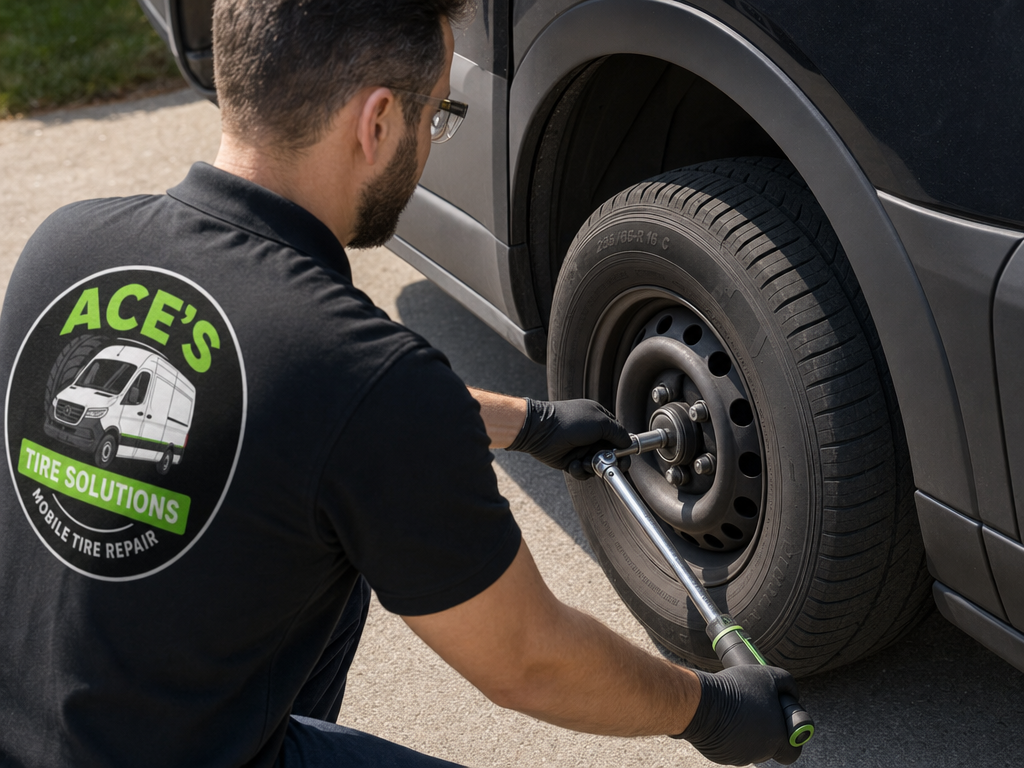
Ask whether lug nuts are torqued with a calibrated wrench to the vehicle's spec. It's a simple question, and the answer tells you a lot about how the rest of the job is done. An installer who takes torque seriously is usually the same installer who checks balancing, inspects valve stems, and doesn't rush the parts of the job you can't see once the wheel's back on.
What Happens to Your Old Tires?
When tires come off, they have to go somewhere. Ask what the installer does with the old set — whether disposal is included in the job or handled separately. It's a small detail, but it's one more thing you don't want to sort out yourself after the new tires are already on the car, especially if you don't have a convenient way to haul four old tires anywhere.
How Does Mobile Scheduling and Location Actually Work?
Mobile installation trades the waiting room for convenience, but it changes a few practical things. Ask where the installer can work — a driveway, a flat parking spot, a workplace lot — and what they need from that space, like clearance and a reasonably level surface.
Ask how far ahead you need to book, and whether the tires are brought to you already selected, or whether that's something you sort out together before the appointment. These are the details that make the difference between a smooth visit and a rescheduled one. It's also worth asking roughly how long the install itself takes once the technician arrives, so you can plan around it rather than guessing.
Scheduled Install or Emergency Call?
If you've got a flat on the side of the road or a tire that's clearly not safe to drive on, that's a different situation than planning a routine set replacement. For an immediate problem, emergency tire service is the right call rather than booking a standard appointment.
If you're comparing providers before committing to a repair versus a full tire decision, the related guide on choosing tire repair walks through that side of the decision in more depth. Knowing which situation you're in — a planned install versus an urgent one — also helps you ask the right questions when you call, since an emergency call is about speed and safety, while a scheduled install is about getting the details right.
Questions and answers
Does mobile tire installation include balancing?
Ask before you book — it should be part of a proper installation, but whether it's included in the quoted price varies, so confirm it directly rather than assuming.
Will my TPMS light come on after a mobile tire install?
It can, if the sensor isn't reset as part of the job. Ask whether TPMS reset is included, especially if your vehicle already has sensors in the wheels.
Can a mobile installer work on my old tires at my house?
That depends on the space available — ask what surface and clearance the installer needs before the appointment so there's no surprise on the day.
If you're ready to book or still have questions about how mobile installation would work at your location, contact Aces Mobile Tires to talk it through before you decide.